4. University as the laboratorium for experiments
Among all the things that Aceh has implemented to prepare for disasters, local wisdom is the most interesting. Evidently, Japan is still studying the local wisdom in Aceh so that it can be applied in their country. You know? Why can? Isn't Japan well-established in terms of disaster preparedness? Then why do you still use traditional Acehnese methods? That's it. There is always a way to learn. They continue and continue to carry out research in order to gain new knowledge. They just want to learn from us, why don't we want to learn from them?
For this reason, it is important to continue to preserve Aceh's local wisdom, especially those related to disaster preparation. I am sure and believe that there will be a lot of knowledge about disasters that will come from Aceh.
All the methods I mentioned above can be done without the need for sophisticated technology. Although it is acknowledged that Japan is equipped with supporting technology such as tsunami radar and others. But even so, the essence of salvation is from each of us. Because when a disaster occurs, it is possible that all technology that uses electrical energy will not function. Everyone will return to using traditional methods.
The most important thing is our attitude to remain prepared and learn in facing disasters. Cultivate a conservative attitude towards nature for the sake of survival in the future. By implementing it in Aceh, I am confident and confident that Aceh will be better prepared for future disasters. Even though we cannot prevent disasters, at least we can reduce the impact of existing disasters. Let's make peace with disaster, friends!
Happy Commemoration of the 10th Anniversary of the Aceh Tsunami!
This article was entered into the #10ThnTsunamiAceh Disaster Blog Competition
The delivery of information regarding disaster preparedness is clearly different between adults and children. Children get bored easily and sometimes have difficulty digesting scientific language about disasters. In fact, they as future generations must be the most prepared to face disasters. For this reason, conveying information must be more fun and more interactive.
I and several friends who were members of the Geumeutoe team initiated the idea for the concept of conveying disaster preparation to children. We created a cute yellow elephant mascot named Papa Genk to teach and remind children to always be alert and aware of disasters. So, when a disaster occurs, the children do not panic and immediately remember the messages from Papa Genk about what they should do when a disaster strikes. “I remember Papa Genk's message! I can't panic!"
Papa Genk is planned to be made in the form of animation, augmented reality, comics and posters.
In Japan there is a story telling community which provides a space to tell stories for earthquake and tsunami victims. They explained how the disaster happened and how they were able to fight for their lives. It does seem boring because you have to hear the same story. However, the concept of a story telling community is provided more for visitors who have never heard stories about surviving the Tsunami. This story telling activity takes no more than an hour and is followed by a question and answer session.
In Banda Aceh, this story telling already exists in the tsunami museum and is always held when a group visits the tsunami museum. However, it's good that activities don't always have to be told about certain events. It is better if stories about the tsunami continue to be passed on from parents to children and so on so that they continue to reach the next generation. Because before the tsunami occurred in 2004, Aceh had actually been hit by a tsunami. However, due to this disconnected information, many victims have been lost.
The concept of story telling has been applied by previous generations when they understood the term smong in Simeulue. When the earthquake occurred in 2004, people believed that sea levels would rise some time later and they all climbed to the mountains to save themselves. This made most of the people in Simeulue safe from the tsunami.
The earthquake and tsunami that hit Aceh ten years ago provided a lesson for all of us to remain alert to disasters. Back then, who would have thought that there would be an earthquake that would destroy buildings in a few minutes? And who would have thought that water would spill from the sea and ravage the land? No one was aware, until finally thousands of lives were taken.
After ten years, we can all see the condition of Aceh which has now been transformed into a city with a disaster alert pattern. Evacuation Route Signs are everywhere, the Escape Building stands firmly in several places close to the sea, several tsunami and earthquake scars have become tourist attractions and even the magnificent tsunami museum appears to be a new icon for Banda Aceh. So, is Aceh really prepared for disasters?
We need to study this again. Remember, the Tsunami Drill carried out by the government is annual and many of the facilities built after the tsunami to support disaster prevention are not even maintained. Several tourist attractions whose aim is to make people aware of the enormity of disasters that have occurred only provide feelings of emotion and minimal knowledge so that they are prepared for disasters that will come in the future.
Thank God, last March I had the opportunity to visit Japan for the JENESYS 2.0 Disaster Prevention Course for nine days. In that short time, I learned a lot of lessons and tips and tricks in preventing and dealing with disasters and post-disaster recovery. Some of them are not even remotely related to Japan's technological sophistication. Therefore, I am sure that Aceh can be further prepared for its implementation.
Preparation Before Disaster
Disasters that have occurred are of course good lessons for future prevention. For example, what natural phenomena occur before a tsunami, what should be prepared when a disaster strikes, and how to save yourself when a disaster strikes. Here are several ways to improve preparation for disasters.
To be honest, Aceh still has very minimal or perhaps even no facilities for those who are less physically fit. Like the disabled home in the Ladong area, Aceh Besar. They admit they don't know what to do when an earthquake occurs. They were still in the room and didn't know where to run.
Several of my friends who are members of the Life For Share team several months ago held disaster training activities for them and installed simple equipment for disaster evacuation. Like pulling a long rope so that those who are blind can feel it to get to a safe place. Public areas such as hospitals, malls, museums and offices still do not provide facilities for people with disabilities in Aceh.
5. Facilities for Persons with Disabilities
It would be better for the Banda Aceh Tsunami Museum to also provide a section for learning about preparations for earthquake and tsunami disasters in the future. It would be good for every area that has been hit by a tsunami to have a university that internally studies and researches the tsunami debris that remains around the former area. earthquake and tsunami attacks. This is so that the preparation of an area is more scientifically tested. Apart from researching how disasters occur, universities can also make the latest innovations to reduce the impact of disasters.
For example, in the Chiba area, Japan, the Chiba Science of Institute regularly conducts research on the level of earthquake strength and how to design earthquake-proof home furniture, as well as calculating the speed of tsunami water so that it can estimate the distance of the nearest route to each disaster-prone place. And much more research has been carried out.
In Aceh, there must be a university that studies more deeply so that Aceh can be better prepared to face disasters. So far, only Unsyiah has a master's degree in disaster. In the future, it is hoped that more campuses will focus on disaster research, which is currently still being researched by Japanese scientists. Considering that Aceh has been and has been hit by a tsunami, disaster science must be able to be produced so that it can be used by other countries that have never been hit by a tsunami.
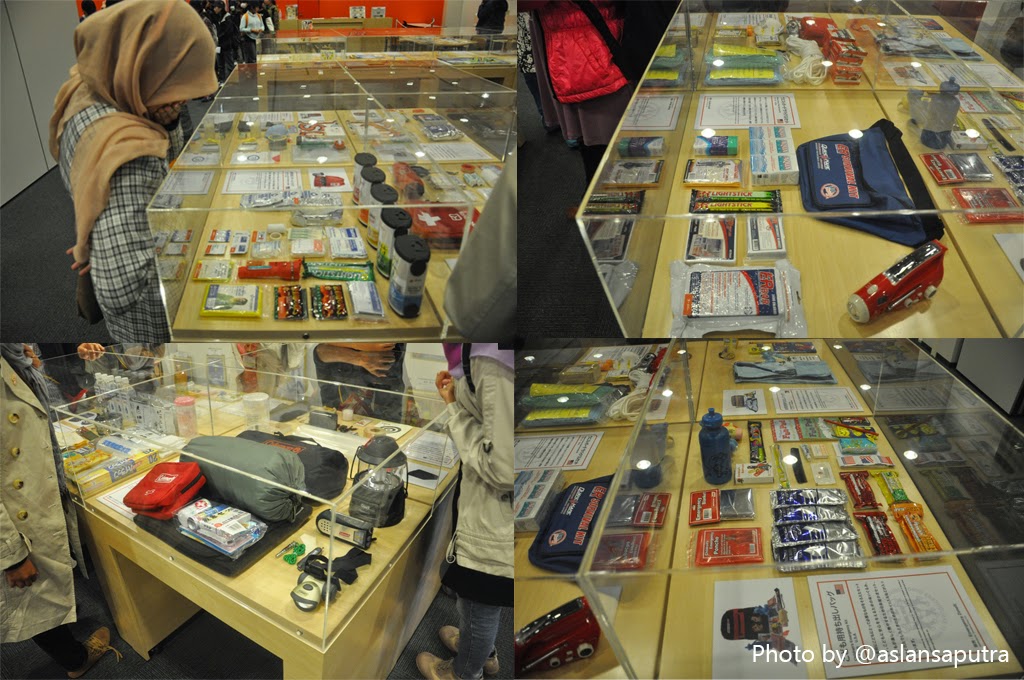
The place we visited in Japan was very different from the tsunami museum in Banda Aceh. If the Banda Aceh tsunami museum is more about remembering the enormity of the tsunami, in the Sona Area Tokyo it is more about teaching visitors about disaster preparedness. There is a simulation of how to survive for 72 hours.
Apart from that, various preparation items for handling different disasters were also exhibited. For example, items that must be provided for children's trauma recovery, items that must be prepared for survival, and several other items that are separated according to needs. Even several used drink bottles were used as makeshift tables.
This place is not only to convey existing history but also more about what preparations we must prepare to face disasters that will occur in the future. This is more effective and educates the public more.
In Japan, every home has a disaster preparedness bag. The contents of a disaster preparedness bag consist of a blanket, canned food that can last up to 3 months, drink bottles, important files, flashlight and medicine. This bag is placed near the door of the house or a place that is easily accessible. So if a disaster occurs, you can immediately take this bag.
At our homestay house we are more preventive. Two helmets were placed directly above the door and tied to a rope tied to the wall near the door hinges. So when you pull the rope, the helmet will lower down. Helmets are used because Japan is very prone to earthquakes.
This standby bag is still very rarely implemented in Aceh. It should be necessary because when a disaster occurs we no longer have time to pack things.
Still related to village disaster preparedness management, in Japan every house has its own evacuation map. In Aceh, this also needs to be provided, because the household does not necessarily understand the conditions in the area where they live, or perhaps there are relatives who have only lived for a day or two and are still confused about how to evacuate.
2. Disaster Preparedness House
In Japan, disaster management is integrated from government to household lines. Everyone is required to understand what they must do as part of the local community for safety against disasters. For example, as a doctor who is treating patients in a hospital, what should you do when a disaster strikes? Likewise for soldiers, office workers, school children and people with disabilities.
Like in the city of Nagareyama where I homestayed for two days. Our mother took us for a walk and explained their village's preparations for disasters. Each hallway has a disaster alert leader who is responsible for disseminating information about disasters to each house under his supervision. Then each head must report to the RT head and so on down to the city level.
Each RT has a different meeting point, remembering that the distance from home to the meeting points is closer. Usually used in school buildings. If the disaster is indicated to be increasingly dangerous, then all residents will be directed to the escape building. For schools that are not meeting points, all students will be directed by their teachers to move to the escape building. This is so that no family members are scattered.
Likewise, offices and government agencies have different disaster mitigation management. Each line is taught to be independent and disaster prevention drills are usually carried out independently by RT, school and office communities. For public places, evacuation route signs are usually provided.
In Aceh, this can also be implemented by making disaster prevention independent from the village level. Each hamlet head is responsible for the safety of his hamlet community.
1. Understand Gampong Disaster Preparedness Management